

Editor’s note: Updated September 2025 to expand sections on IoT, AI, Cloud, and Digital Twins, and to include new FAQs.
Once seen as the center of product definition, Product Lifecycle Management (PLM) now shares the stage with supply chain and manufacturing applications. These tools provide visibility across the entire supply chain and, with the Internet of Things (IoT), even into customers’ real-world use of products. Never has the “single source of product truth” been so real.
Industry 4.0
Industry 4.0 is often described as the fourth industrial revolution—the point where physical operations and digital intelligence converge.
For manufacturers, the magic of Industry 4.0 lies in how its core technologies reshape PLM and the supply chain. Instead of siloed tools that pass information along in sequence, these capabilities create a connected, continuous lifecycle:
-
IoT turns products and equipment into data streams feeding back into design and service.
-
Big Data converts those streams into insights that break down silos across engineering, quality, and operations.
-
AI transforms insights into predictions and decisions that scale across the enterprise.
-
AR closes the loop between digital and physical, enabling real-time visualization and field feedback.
-
Autonomous Robotics execute changes on the factory floor with minimal human intervention.
-
Digital Twins mirror the product’s life virtually, unifying “as-designed,” “as-built,” and “as-used.”
-
Cybersecurity protects the digital thread that ties it all together.
Together, these technologies move PLM from a static record system into the operating backbone of modern manufacturing—driving speed, adaptability, and profitability.
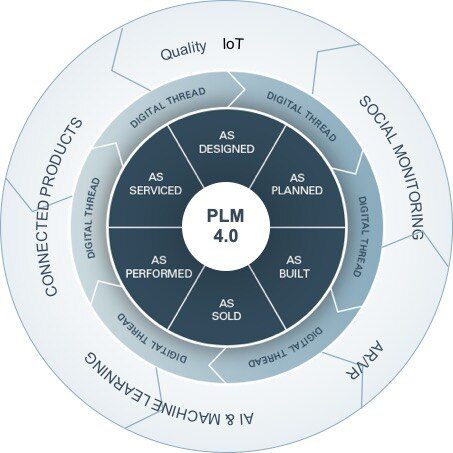
PLM 4.0 connects the entire lifecycle—linking design, manufacturing, and service through the digital thread.
Internet of Things (IoT)
IoT isn’t just about “connected devices”—it’s about turning physical product usage into a continuous digital feedback loop. In PLM, IoT means sensors in products, equipment, and even packaging that stream data back into the lifecycle record.
For supply chain and PLM leaders, this translates into:
-
Real-world usage data – how customers actually use products vs. how engineers designed them.
-
Performance monitoring – machines reporting vibration, temperature, or efficiency to trigger service events.
-
Remote updates – products that evolve post-sale via firmware pushes, linked to PLM change records.
-
Sustainability tracking – IoT-enabled traceability of materials and energy use across the supply chain.
The outcome: PLM is no longer static “design intent.” IoT ties the digital thread directly into in-service life, creating a closed loop between design, manufacture, and usage.
Big Data
Big data isn’t just volume—it’s velocity and variety. In PLM, that means pulling sensor readings from IoT devices, customer usage data from the field, and production metrics from factories—and then aligning all of it against product records. The value is not in the raw data but in how it’s aggregated to reveal patterns:
-
Early detection of quality issues before they trigger recalls.
-
Benchmarking supplier performance across regions.
-
Feeding design teams with real-world usage insights.
Big data moves PLM from a static repository into a predictive tool that shapes decisions upstream.
Cloud Computing
The cloud is the backbone of Industry 4.0. It’s what makes the digital thread practical by connecting global teams, suppliers, and systems to the same source of truth. In PLM, the cloud enables:
-
Universal accessibility – engineers, suppliers, and service teams can access product data anywhere, anytime.
-
Real-time collaboration – design changes, BOM updates, or compliance documents are visible instantly across the supply chain.
-
Elastic scalability – storage, compute, and simulation capacity expand on demand, without costly infrastructure.
-
Continuous updates – security patches, new features, and integrations are delivered without disruption.
Cloud isn’t just cheaper infrastructure. It’s what allows PLM data to flow seamlessly across the lifecycle—supporting connected IoT streams, AI-driven analytics, and global collaboration. Without the cloud, Industry 4.0 collapses back into disconnected islands.
Artificial Intelligence (AI)
AI is the engine that turns PLM data into action. Instead of engineers combing through reports, machine learning models can flag anomalies, predict component failures, or recommend design changes. In supply chains, AI enables:
-
Automated classification of parts and BOM items.
-
Predictive demand planning tied directly to PLM data.
-
Intelligent workflows that adjust routes or approvals based on historical patterns.
AI isn’t just about “decisions like a human”—it’s about scaling expertise across thousands of processes simultaneously.
Augmented Reality (AR)
AR is often dismissed as a gimmick, but in PLM it closes the loop between digital and physical. Service technicians can overlay repair instructions on a machine in the field; engineers can visualize digital twin performance data over a real prototype. This matters because:
-
Field feedback can flow directly back into the PLM system.
-
Training time for new employees shrinks.
-
Product updates can be validated in mixed reality before tooling is cut.
While adoption is uneven, the companies that deploy AR see measurable gains in service efficiency and fewer design-service disconnects.
Autonomous Robotics
Robotics in the supply chain isn’t new—but robotics tied into PLM is. Imagine a change order pushed from PLM that immediately updates robot instructions on the line. No spreadsheets, no delays. These robots, informed by AI and IoT, can:
-
Reconfigure themselves for new products faster.
-
Handle edge-cases humans traditionally managed.
-
Provide real-time production data directly into the product record.
This shortens the gap between design intent and manufacturing reality.
Digital Twin
A digital twin is more than a 3D model—it’s a living, data-fed replica of a part, assembly, or product in operation. By connecting CAD models, simulation tools, and IoT sensor data, companies can mirror the real-world behavior of products in a virtual environment.
For PLM and supply chain, this unlocks:
-
Design validation before physical prototypes – engineers can simulate stress, wear, and performance under real conditions.
-
Predictive maintenance – IoT-enabled twins flag when equipment will fail, reducing downtime.
-
Closed-loop feedback – field performance data continuously refines the product record, so future designs improve.
-
Faster regulatory approval – digital proof of compliance reduces time-to-market in heavily regulated industries (e.g., medical devices, aerospace).
Digital twins shrink the gap between “as-designed,” “as-built,” and “as-maintained,” making PLM data actionable at every stage of the lifecycle.
Cybersecurity
As PLM data becomes the digital thread across design, suppliers, and service, it becomes a prime target. A breach here doesn’t just expose intellectual property—it disrupts production, regulatory compliance, and customer trust. Strong PLM 4.0 implementations:
-
Encrypt data across all integrations (ERP, MES, IoT).
-
Govern access rights with role-based controls.
-
Build audit trails so compliance teams can trace every change.
Without cybersecurity, Industry 4.0 collapses under its own weight.
The Impact of Industry 4.0 on PLM
In a recent webinar with Oleg Shilovitsky (CEO of OpenBOM, founder of Beyond PLM), he described how Industry 4.0 is shaping “connected PLM”—a PLM without borders that links users and decision-makers to vast networks of data.
PLM 3.0 vs. PLM 4.0
-
PLM 3.0 (Legacy PLM)
-
Focused on document control and workflow.
-
Integrates with ERP, CAD, and supply chain systems, but mostly in a point-to-point, sequential manner.
-
Data is digital, but access is fragmented—each function consumes information at its stage, then passes it along.
-
Suited to companies that could tolerate long change cycles and linear processes.
PLM 4.0 (Connected PLM)
-
Moves from managing files to managing a digital thread of structured data.
-
Data and processes are virtualized—always accessible, not just at hand-off points.
-
IoT, AI, and Digital Twin feed real-world performance data back into design and service.
-
Collaboration shifts from “request and wait” to continuous visibility across the lifecycle.
-
Supports new business models (product-as-a-service, rapid customization) that legacy PLM cannot.
His takeaway: PLM 3.0 digitized engineering processes; PLM 4.0 connects the entire product lifecycle in real time.
-
Unlocking Industry 4.0 Potential
The benefits of PLM 4.0 include faster cycles, lower costs, fewer quality issues, and more customer-driven innovation. Oracle, for example, describes their 4.0-enabled PLM as one that:
-
Links customer feedback directly to the product record.
-
Leverages IoT, AI, Digital Twins, and quality analytics to close information gaps.
-
Runs on a single common data model with built-in PIM for commercialization.
-
Embeds analytics and social tools to drive decisions and collaboration.
-
Connects silos and stakeholders with a digital thread.
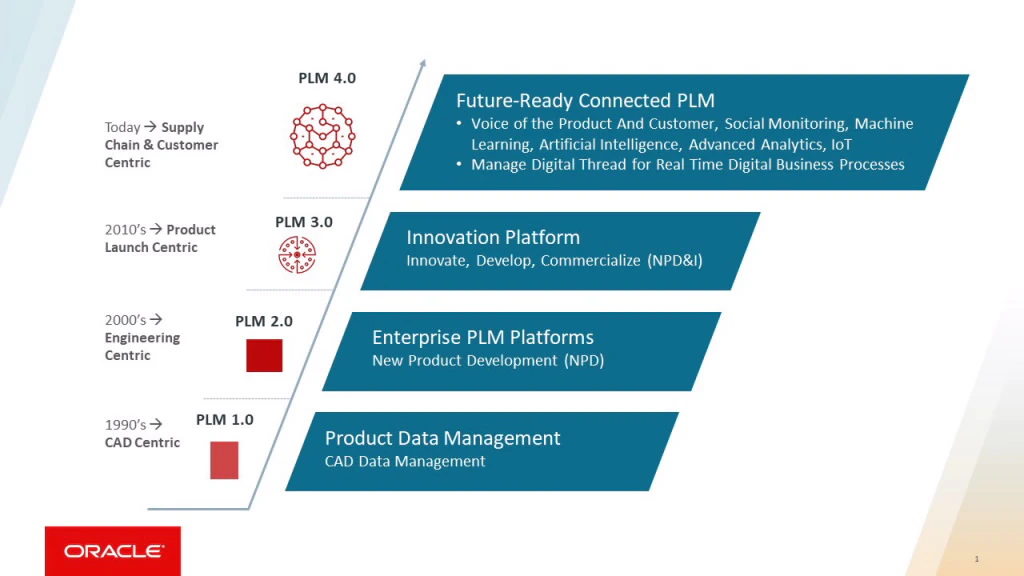
The evolution of PLM: from CAD-centric PLM 1.0 through product launch and engineering stages, to PLM 4.0’s connected, customer-centric future.
Which Applications Are Truly PLM 4.0-Enabled?
The definition varies by vendor. True PLM 4.0 requires a single source of data accessible across all applications—not partial integrations limited by vendor ecosystems. While platforms like Oracle’s Modern Supply Chain embrace 4.0, interoperability remains the key challenge.
The takeaway: Industry 4.0 capabilities exist today. Companies that delay adoption risk falling behind competitors already using these tools.
Society 5.0
While Industry 4.0 is about technology, Society 5.0 shifts the focus to people. Introduced by Japan, it envisions a human-centered society where digital transformation directly addresses social challenges—healthcare, mobility, sustainability, and equality.
Key themes include:
-
Integration of cyberspace and physical space – not just connecting machines, but embedding intelligence into daily life.
-
Technology in service of society – using AI, IoT, and robotics to improve quality of life rather than just efficiency.
-
Balanced progress – advancing economic growth while closing gaps in access, equity, and sustainability.
For PLM leaders, Society 5.0 raises an important question: how do our lifecycle systems not only drive profit, but also align with broader social outcomes? It suggests that the next evolution of PLM will extend beyond product efficiency—toward designing products and processes that directly contribute to societal well-being.
The Here and Now
Today, most companies are racing to modernize legacy applications to align with PLM 4.0. The challenge lies in selecting solutions that not only integrate seamlessly but also position the organization for tomorrow’s demands.
PLM is no longer static—it’s evolving with Industry 4.0 and shaping the supply chains of the future.
FAQ
What is PLM 4.0?
PLM 4.0 refers to connected Product Lifecycle Management systems that go beyond document control. Unlike legacy PLM, PLM 4.0 uses cloud, IoT, AI, and digital twins to make product data continuously accessible across design, manufacturing, supply chain, and service.
How does Industry 4.0 affect PLM?
Industry 4.0 technologies—IoT, big data, AI, robotics, and digital twins—feed directly into PLM systems, creating a digital thread from concept to service. This shifts PLM from static recordkeeping to an active decision-making platform.
What’s the difference between PLM 3.0 and PLM 4.0?
PLM 3.0 digitized engineering processes but kept data siloed. PLM 4.0 virtualizes processes and data, providing real-time access and closed-loop feedback across the entire product lifecycle.
Why is IoT important for PLM?
IoT turns products and equipment into data sources. That data flows back into PLM, giving engineers visibility into real-world product performance, enabling predictive maintenance, and improving future designs.
What role does cloud play in Industry 4.0 and PLM?
Cloud platforms allow global teams to work from a single source of truth. They provide scalability, universal access, and continuous updates—making it possible to connect IoT streams, analytics, and supply chain applications.
What is a digital twin in PLM?
A digital twin is a virtual model of a product or system linked to real-world data. It allows companies to simulate, monitor, and optimize performance throughout the lifecycle, reducing cost and accelerating time to market.
What is Society 5.0, and how does it connect to PLM?
Society 5.0 is a Japanese initiative that shifts focus from technology to people—using digital transformation to solve societal challenges. For PLM, it suggests a future where lifecycle management not only drives profit but also contributes to sustainability, equity, and quality of life.