
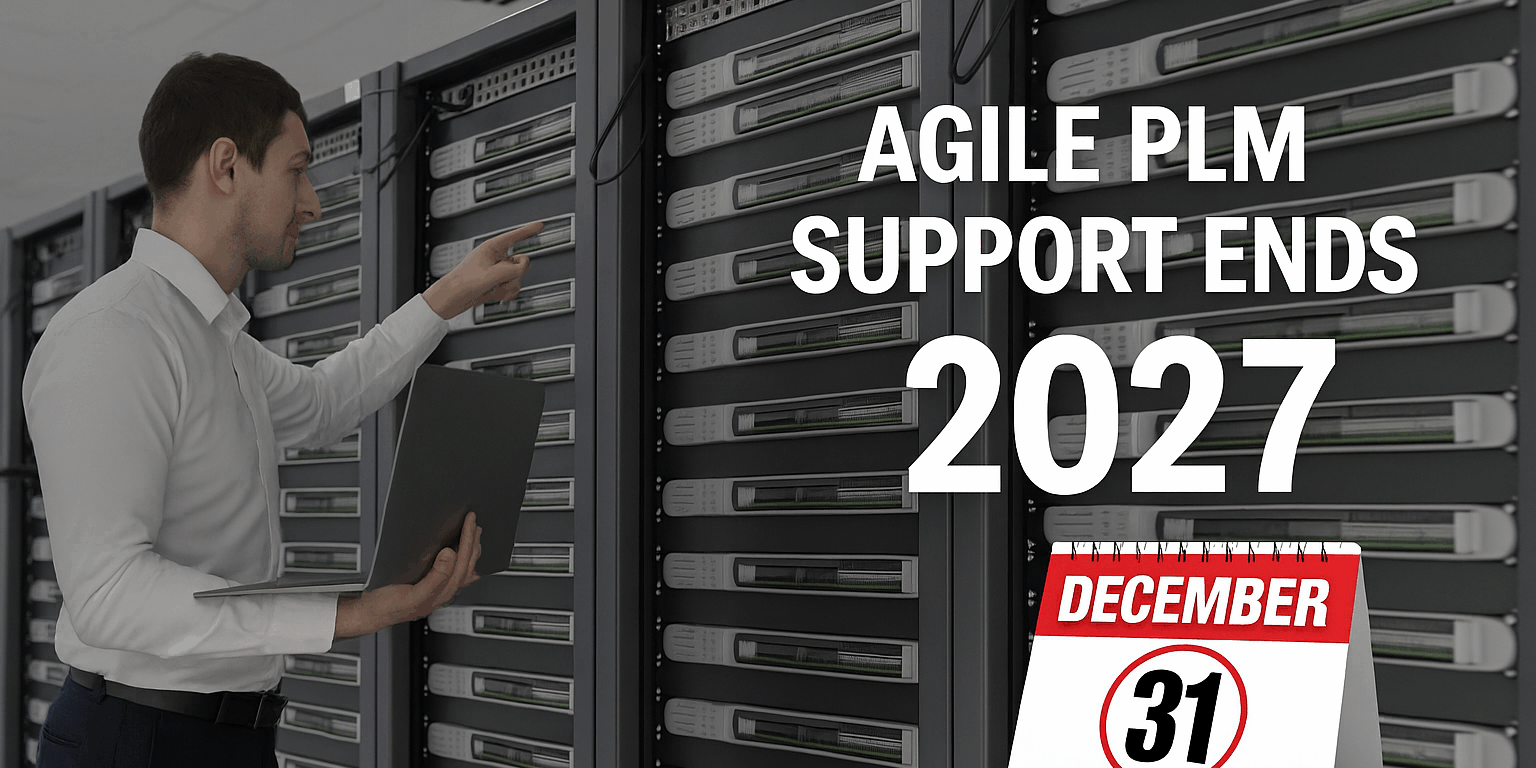
Prior to becoming a PLM consultant, I spent a decade at Dell keeping our Oracle Agile PLM instance humming and helping with Agile PLM migration projects inside the company. I know the quirks, the customizations, and the firefighting that goes with it. But the clock is ticking. Oracle has confirmed that Premier Support for Agile 9.3.x ends on December 31, 2027 — after that, it drops into Sustaining Support with no new patches, security fixes, or critical-bug updates. See our full Agile PLM End of Life announcement.
Running a mission-critical platform without security patches is like leaving the server room door propped open. Cyber risk aside, auditors won’t look kindly on an unsupported backbone system, and every quarter that passes makes it harder to find people who still speak “Agile.”
If you’re still on Agile, now is the time to act. Below is the 8-step playbook I’ve outlined to safely move to a modern cloud PLM platform.
Start planning now — the runway is shorter than it looks.
Why Start in 2025 Instead of 2027?
-
Resource Scarcity: The same Agile SMEs, tooling, and third-party experts are in high demand.
-
Data Cleansing Takes Time: For large enterprises, just archiving and deduping can take 6–12 months.
-
Budget & Roadmap Planning: Most multi-year projects need early approval to align with capital planning cycles.
-
Security Exposure: Once Oracle stops issuing Critical Patch Updates, every unpatched CVE is a risk multiplier. One example: Oracle Agile PLM vulnerability CVE-2024-21287
1 | Build the Business Case & Secure Executive Air Cover
-
Total Cost of Delay: Quantify the cost of a single day of unplanned downtime or a data breach investigation.
-
Competitive Advantage: Show how SaaS PLM platforms can reduce change cycle times and accelerate NPI (New Product Introduction).
-
Audit & Risk Exposure: Highlight the impact of operating unsupported software, especially in regulated industries.
2 | Inventory & Cleanse Your Data
-
BOMs, AML, Change Orders, Quality Records: Export counts and sizes; flag duplicates or stale records.
-
Custom Objects & Attributes: Identify which ones are still in use — many Agile customizations are now standard in modern platforms.
-
File Attachments: Categorize CAD, specifications, and compliance docs; archive or remove obsolete files.
For a structured way to approach this, see our Agile PLM Health Check, which benchmarks data quality, configuration, and usage against best practices.
3 | Map Your Future-State Processes
“Lift-and-shift” ≠ transformation. Don’t just port legacy workflows — streamline and modernize using today’s best practices (for example, closed-loop quality, integrated quality and product data).
Bring in Engineering, Quality, Supply Chain, and IT early. Resistance late in the process will cost time and trust.
4 | Choose Your Destination & Migration Strategy
Consider factors such as regulatory alignment, ERP/CRM integration needs, and workflow flexibility when choosing a modern cloud PLM platform. Most companies evaluating Agile PLM migration today consider Propel (Salesforce-native), Arena (by PTC), and in some cases, other cloud vendors — each offering different strengths depending on compliance, integration, and usability requirements.
5 | Rebuild Integrations & Replace PXs
Most Agile PLM environments are deeply integrated — with ERP, MES, QMS, CAD systems — and often include custom PXs (Process Extensions) and Event Handlers. As you migrate to a modern SaaS PLM, rethink how these integrations and customizations are handled.
-
Inventory all integrations: document source/target systems, data types, frequency, and technology (Java, XML, APIs).
-
Triage each connection: Retire obsolete ones, replace with native tools or SaaS connectors (Boomi, MuleSoft), or rebuild critical integrations using modern REST APIs.
-
Modern PLM platforms don’t support PXs, but offer configurable workflows, conditional logic, calculated fields, validation rules, and platform-based automation.
Use this opportunity to eliminate technical debt instead of replicating every legacy customization 1:1. Many workarounds from Agile are now standard features.
Migration partners often have prebuilt integration templates and data-mapping accelerators — saving significant time and risk.
6 | Select a Proven Migration Partner
-
PLM Migration Expertise: Agile export/import tooling is highly specialized and declining in availability.
-
Data Mapping Templates: Partners bring pre-configured templates to translate Agile XML exports to modern cloud PLM formats.
-
Availability Crunch: Migration calendars are filling — early booking gives you more control over your go-live window. Agile-specific expertise is also vanishing fast, with many in-house IT teams no longer maintaining migration tooling. Securing a partner early reduces risk and keeps your timeline in your hands.
7 | Pilot, Validate, and Train
Run a dry run before cutover.
-
Pilot Environment: Import a representative subset — items, BOMs, ECOs — and run test workflows.
-
Validation Scripts: Ensure compliance coverage (FDA, ISO 13485, ITAR) and system stability.
-
Training: Don’t just teach the new UI — walk users through what changed in their processes and why, focusing on the benefits and flexibility of the cloud.
8 | Cutover & Hypercare
-
Change Freeze: Pause non-critical updates in Agile just before cutover.
-
Final Delta Extraction: Capture last-minute ECOs and late-breaking changes.
-
Hypercare Sprint: Daily stand-ups post-go-live to triage and resolve adoption issues quickly.
Final Thoughts
Don’t wait for the 2027 cliff. Treat your Agile PLM migration as a once-in-a-decade opportunity to modernize your engineering toolbox, tighten your integration architecture, and give product teams the cloud-native tools they’ve been asking for.
The earlier you start, the more control you’ll have — over budget, schedule, and business continuity. Every quarter you wait narrows your options. Treat this as more than a risk response — it’s a chance to modernize how your teams work.
How Domain Systems Supports Agile PLM Migrations
-
30+ years of guiding Agile customers through complex PLM transformations
-
Prebuilt data mapping templates and accelerators for migration projects
-
Proven process for data extraction, cleansing, enrichment, and validation
-
Cutover and hypercare support to minimize disruption