
“What is going to happen to Agile PLM… and when is it going to happen?”
I wish I could tell you the number of times I have been asked that question. What is going to happen, indeed?
As a stakeholder, you have been left in limbo. It is like PLM platform longevity. There have been a lot of rumors, user uncertainty, and vendor silence. For better or worse, the situation is coming to a head. It is decision-time and I want to make sure you are ready for it.
In a 2019 interview with Oracle’s CIO, Larry Ellison, he discussed the layoffs that had been turning many heads. He explained how some of Oracle’s businesses are “melting away – specifically on-premise applications and how they will now focus on star products (all cloud-based) in order to continue improvement of the topline.
What is the latest version of Agile PLM?
Oracle Agile 9.3.6 is the most current version available (as of 10/23/2023). After 2027, this version will no longer have Premier Support and sustaining support will continue after 2030.
What we know
2016 – Oracle announces end of waterfall updates in favor of Cloud SaaS
2017 – Introduction of Release Update Packs
(Release Update Pack, colloquially known as “RUPs”)
Oracle moved Agile PLM to a Release Update Pack “RUP” approach of product update – essentially a bug fix with “as-needed” feature additions for the latest active versions of Agile. Support documentation indicates that Agile 9.3.6 is now scheduled to end Premier Support in 2027. Agile 9.3.5 is no longer active and has very limited Oracle support.
Oracle Lifetime Support Policy December 8, 2021
Oracle has made no secret that the future lies within the Cloud. While it appears the on-premise Agile PLM’s end clock is almost out of battery, the good news is that PLM as well as an entire supporting – and integrated – suite of supply chain applications architecture specifically for the cloud are now available.
Based on the above, you might come to the conclusion that Agile PLM has indeed run its course.
What to do? (It depends.)
Agile PLM users considering moving to the cloud often ask us, “how much longer can I stay with Agile- a proven, albeit matured application?”
The fact is that your migration from Agile PLM will inevitably have to happen… and soon.
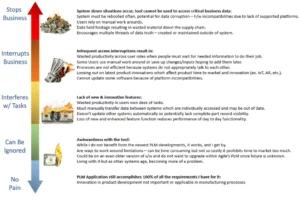
But you have to evaluate your situation to determine whether your business is experiencing any pain and to what degree.
The graphic below helps to check the pulse on your Agile environment:
My Recommendations
There are some common-sense next steps forward:
- Develop an ROI strategy. Determine what is working and bringing value in Agile PLM versus the cost and effort of any alternative. A timeline should be short to mid-term in order to mitigate the long-term loss of productivity.
- For Agile PLM owners still on support, maximizing value may include upgrading to the latest version (9.3.6) to gain full support value. Subsequently, begin an evaluation for a migration to the next generation PLM. This creates a bit of a time cushion in order to evaluate Oracle’s next-generation cloud offering against other competitive options whether on-premise or cloud.
- Consider where the future is taking PLM. There are many innovations underway or planned that compliment PLM and/or general supply chain functionality that can extend the viable life, ROI, and functional value well into the future.
There are many innovations underway or planned that compliment PLM and/or general supply chain functionality that can extend the viable life, ROI, and functional value well into the future.
Check out our webinar: The Oracle Agile Road Map: Plow Ahead or Time for a Lane Change?
Cloud Vs. On-Premise
All major PLMs are on board in one definition or another (hosted to true SaaS) with Cloud as the platform of the future. Smaller standalone solutions like Arena, Propel, and OpenBOM are only offered via SaaS/Cloud. The traditional major PLM vendors like PTC, Teamcenter, Aras, Enovia, and others also all have a cloud offering. Some, like PTC for instance, will continue to support and offer either option with duplicating application functionality even though the Cloud offering is re-architected for true SaaS.
Get Someone In Your Corner
Several of our Agile PLM clients have worked through these decisions and have come out on top. In all cases, clients maximize value while managing and minimizing pain as they make the transition.
Here is what has worked for them:
- Evaluate motivation & pain
- Determine the best road map with timing
- Move within Oracle applications to Cloud or even migrate outside the Oracle footprint when it best meets future innovation criteria
- Buy time by upgrading to the latest Agile PLM version 9.3.6 in order to keep all h/w and s/w compatibilities safe, ensure bug fixes/patches, and any application improvements that may come out in RUPs
- Domain Systems offers a support program that provides an upgrade to the latest version and provides a managed service for Agile PLM application support. We free the client from further investment into old technology to focus on future technologies for both personnel and application infrastructure.
- Budget/Plan/Execute the move to next-generation PLM
The key benefit to this approach is to maximize ROI on a mature PLM while securing time to make the best decision for the client over the next year or two. This balanced strategy reduces risk from hastiness and encourages corporate alignment for maximum longevity of the next investment. Costs are reduced by creating a more reliable plan that can thoroughly be examined for efficiency.
Closing Thought
From my experience, and because of the accelerated growth and innovation being seen in today’s second-generation of SaaS PLM solutions, that time for most Agile customers to get off the fence has already arrived.