
Third-party support can reduce maintenance costs and extend the life of an Agile PLM environment. But support and strategy are not the same thing. This article explores where third-party support fits, where it falls short, and why many manufacturers view it as a bridge rather than a destination.
For many manufacturers, Agile PLM has been the backbone of product development, engineering change management, quality processes, and product record management for years.
As organizations evaluate the future of their Product Lifecycle Management (PLM) environments, some are considering third-party support providers as a way to reduce maintenance costs and extend the life of existing Agile PLM deployments.
While third-party support can offer immediate savings, it is important to recognize that cost reduction alone does not address the larger strategic challenges facing Agile PLM users.
Manufacturers that rely exclusively on third-party support may find themselves preserving a legacy system rather than preparing for the next generation of digital product development.
The Challenge Facing Agile PLM Customers
Agile PLM remains a mission-critical platform for many organizations, but manufacturing environments have evolved significantly since many Agile implementations were first deployed.
Today’s manufacturers require tighter integration with cloud applications, enhanced supplier collaboration, real-time visibility across global operations, advanced analytics, and support for digital transformation initiatives.
The question is no longer whether Agile PLM can continue to operate. The real question is whether maintaining the status quo positions the business for future growth and competitiveness.
Third-Party Support Extends Maintenance, Not Innovation
Third-party support providers excel at helping organizations keep existing systems running. They can troubleshoot issues, provide technical assistance, and often reduce annual support costs.
What they cannot provide is a product roadmap.
Unlike Oracle, third-party providers do not develop Agile PLM, release new functionality, invest in product innovation, or create future platform enhancements.
As a result, manufacturers that move entirely to third-party support may find themselves disconnected from evolving PLM strategies and emerging technologies.
In effect, third-party support helps preserve the current state but does little to advance the business toward future objectives.
Security and Compliance Requirements Continue to Evolve
Manufacturers operate in an increasingly regulated and security-conscious environment. Product data, intellectual property, supplier information, and quality records represent some of the organization’s most valuable assets.
As cybersecurity threats evolve, organizations need access to security updates, vulnerability remediation, platform certifications, and ongoing software maintenance.
While third-party support providers can offer operational assistance, they typically cannot deliver the same level of direct product engineering support or future security enhancements available through the software vendor.
Over time, maintaining aging infrastructure without a modernization strategy can increase both security and compliance risks.
Integration Demands are Growing
Modern manufacturing ecosystems rely on seamless connectivity between PLM, ERP, MES, quality management, supply chain, and engineering applications.
As companies adopt cloud platforms and digital manufacturing initiatives, integration requirements become increasingly complex.
Legacy Agile PLM environments often require additional customization and maintenance to support these evolving business needs.
Third-party support can help sustain existing integrations, but it does not solve the broader challenge of aligning PLM technology with modern enterprise architectures.
Technical Debt Doesn’t Disappear
One of the most common misconceptions about third-party support is that it eliminates costs. In reality, it often shifts costs into the future.
By delaying modernization efforts, organizations accumulate technical debt.
Customizations become harder to maintain, infrastructure ages, specialized skills become more difficult to find, and integration complexity grows over time.
Eventually, manufacturers may face a larger and more urgent transformation project than if they had proactively planned their PLM roadmap.
A Strategic Alternative
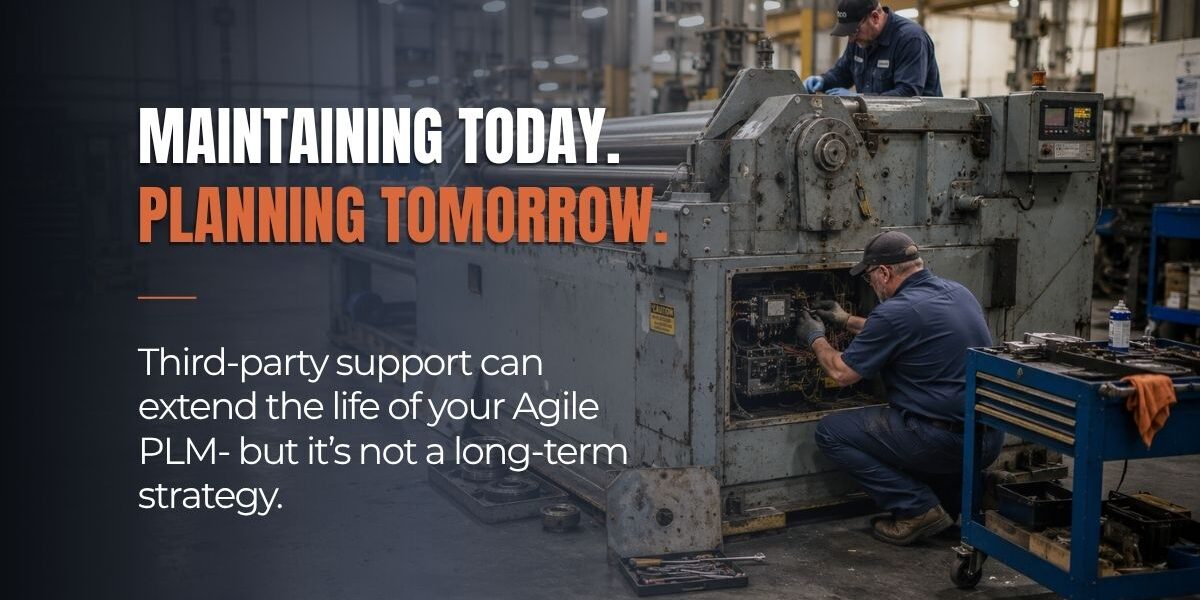
Rather than viewing third-party support as a permanent destination, manufacturers should consider it a tactical bridge.
The goal should not simply be to keep Agile PLM running for as long as possible, but to determine how PLM can support the organization’s future business objectives.
This may involve evaluating cloud-based PLM platforms, modernizing existing processes, improving integration strategies, or developing a phased migration roadmap.
The most successful organizations use support decisions as part of a broader digital transformation strategy rather than as a standalone cost-cutting exercise.
Conclusion
Third-party support providers can offer short-term financial relief for organizations running Agile PLM, but they are not a substitute for a long-term PLM strategy.
While these providers help maintain legacy environments, they do not deliver product innovation, future platform enhancements, or a roadmap for digital transformation.
For manufacturers seeking to improve agility, strengthen security, enhance collaboration, and support future growth, the focus should be on modernization and strategic lifecycle management, not simply extending the life of legacy systems.
The organizations that gain the most value from Agile PLM will be those that use today’s support decisions to build tomorrow’s product development capabilities.
Evaluating the next chapter of your Agile PLM strategy?
Third-party support, modernization initiatives, and migration planning each solve different problems. The right approach depends on your business objectives, risk profile, and long-term roadmap.
FAQ
What's third-party support for Agile PLM?
Third-party support providers offer maintenance, troubleshooting, and operational assistance for existing Agile PLM environments outside of Oracle support agreements. Services often include issue resolution, technical guidance, and support for existing configurations and customizations.
Can organizations continue running Agile PLM using third-party support?
Yes. Third-party support can help organizations maintain stable Agile PLM environments and may provide additional time to evaluate modernization options or develop a long-term PLM strategy.
However, extending support does not eliminate the underlying planning considerations associated with aging infrastructure, evolving integration requirements, technical debt, and future business needs.
For many manufacturers, third-party support functions most effectively as a tactical bridge rather than a permanent destination.
Does third-party support include new Agile PLM features or product enhancements?
No. Third-party support providers typically do not develop new functionality, release product enhancements, or maintain a future product roadmap for Agile PLM. Their role is generally focused on maintaining and supporting existing environments.
Is third-party support a replacement for a long-term PLM strategy?
For many organizations, third-party support serves best as a tactical bridge rather than a permanent destination. Long-term planning often includes evaluating modernization initiatives, integration requirements, cloud strategies, and future business objectives.
When should organizations begin evaluating Agile PLM modernization options?
The right timeline varies by organization, but many manufacturers begin planning when infrastructure ages, integration complexity increases, support models change, or business requirements begin to outpace the capabilities of the current environment.