

The Agile PLM platform is a powerful, proven, flexible solution to PLM needs. It’s been around in one form or another since the early 2000’s. It has provided extensive product development solutions for many industries.Users often assume that on-premise Agile PLM remains viable well into 2030, suggesting its suitability for users resistant to cloud migration. The choice to continue using Agile implies confidence in its longevity and effectiveness.
In 2017, Oracle introduced a Release Update Pack “RUP” approach to improving Agile PLM – essentially as a bug-fix solution set with “as-necessary” feature additions for only the then latest two active versions of Agile. Oracle announced the end of premier support for Agile 9.3.5 and 9.3.6 in 2021 and 2022 respectively. Since then, Oracle extended Premier Support to August 2027. The timing for extended support is December of 2030.
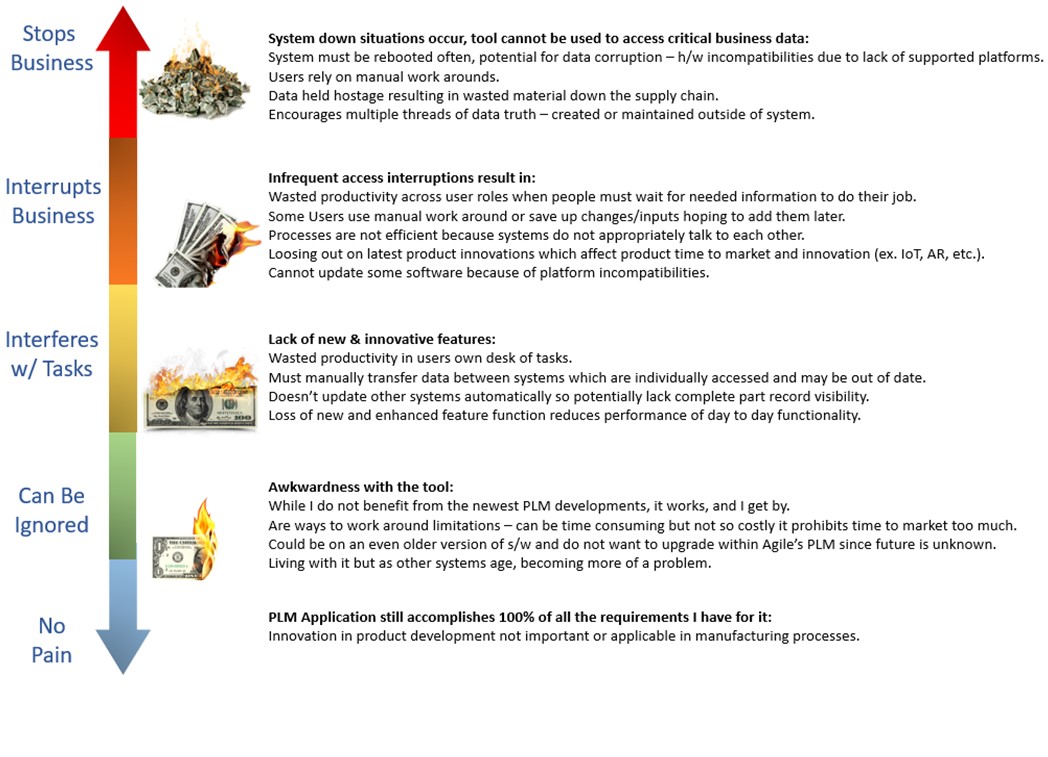
Users could properly assume that on-premise Agile PLM remains a viable solution well into 2030. This suggests on-premise Agile PLM remains viable for cloud-resistant users till then. The client determines the cost imposed by such a choice and the perceived cost of not moving to next-generation critical applications in their company. The graphic below illustrates varying pain levels related to the need to update to new PLM software.
If your choice is to continue using Agile, then let’s make the most of it!
Before delving into strategies to enhance Agile usage, it’s essential to recognize the imperative for a proactive migration plan to next-gen software. This ensures a seamless and productive transition when the time arrives. Prudence dictates acknowledging this urgency and preparing accordingly for the future.. Time and money will be saved, sometimes a lot of it!
Using Agile PLM Better
Too often, clients purchase and implement only a primary or initial function or module of PLM. Initial implementations may fail to fully meet an organization’s needs. This creates a wish list or “should haves” that reflect the lack of having a better solution in place.
Do any of these sound familiar:
- “We just need to get off these spreadsheets and automate the product development process…”
- “Information is not being moved between design and manufacturing, the process is broken…”
- “Our current system is sluggish, people are working around it, defeating its purpose and creating breakdowns…”
- “If only we could manage the new product introduction as a project with the ability to draw in products on work we’ve already done, we could save a bunch of time”
- “I know we’re at risk if we were audited by our OEM; we’re just not complying with the security and document capture requirements”
and on and on.
When the initial need is met, pressure is off and life proceeds as usual. Improvement is always lurking in the background, but day-to-day fires take precedence, pushing the initiative to the back burner indefinitely. Soon, all thoughts disappear until enough pain is felt once again to make the change. It’s a self-defeating cycle. What are the hard and soft costs of not self-improving? An honest assessment will usually indicate they are significant!
Additionally, many face the “I don’t know what I don’t know (but I should)” syndrome. Improvement and savings come from reaching out to those who do know, and constantly evaluating and changing to take advantage of the available tools.
Common Areas to Realize Greater Return on a Client’s Enterprise Investment
Workflow Efficiency
Workflow, along with lifecycle management, is fundamental to PLM. These changes can improve with organizational change. When paired with industry best practices, and efficiently tied to connecting applications such as ERP, SCM, and MES, control is ensured, as well as accuracy in information across the supply chain from design through manufacturing.
The proper configuration ensures best practice, decreases the time to market of a product, and minimizes errors all while capturing information for continued improvement of a client’s processes. When compliance and quality are critical to a workflow, understanding the industry vertical is key to the configuration and design of workflows and lifecycles.
Examining the data within a system enables users to access and streamline information according to specific needs, ensuring proper reporting throughout the process. Configuration includes capturing existing and new data into the data objects.
Auditing and creating new workflows means keeping it simple. Unnecessary steps, or steps once needed but that are now antiquated by the introduction of a new process, application, or industry direction change can create clutter that bogs systems down.
The following client workflows are examples of areas to examine for audit and improvement. Examining workflow steps, properties, information, trigger points, integration steps, and more may bring any issues to light.
| General Activity | ATO | Audit |
| CAPA | ECO/MCO | ECR/MCR |
| CTO | Declarations | Deviations |
| Doc Handling | Gates | Non-Conformance |
| Packages | Problem Reports | Stop Ships |
Security Models
The need to protect the product development and lifecycle processes from internal and external threats, and even cybercrime, is critical. This should be an ongoing effort. Ensuring security in PLM involves granting access only to the right roles at the right times, and at the right step in the workflow.
When configured or customized appropriately, PLM provides robust security solutions. These solutions can be deployed and maintained with ease across the lifecycle management processes.. Depending on the industry vertical requirements, you can also implement advanced procedures. These include export control (ITAR), non-disclosure agreements, and supplier security. Also important to an audit is the alignment of information protection and user access requirements with advanced security protocols for application and IT infrastructure to safeguard your most valuable product information and protect contractual relationships.
Performance improvements
System performance often deteriorates over time. This can be anything from missing the latest software patches/fixes to accumulated errors in the database. Agile PLM, for example, has an internal tool called Averify meant to verify the integrity of the underlying database schema. Averify will report back accumulated errors that must be fixed, usually via supplied scripts and sometimes manually. Ignoring these errors risks the overall health and performance of the application and its data.
A comprehensive improvement review covers all related installed software, license use, developed customizations, SSL needs/configuration, replicated file locations and usage, technical integration points, and more.
Full PLM Module Usage
There are five primary modules a company can implement to fully take advantage of what Agile PLM has to offer. They are:
Agile Product Collaboration (PC) – Management and collaboration of product record information throughout the product lifecycle, across internal organizations, and the extended supply chain. Accessed through Web Client and Java Client.
Agile Product Governance & Compliance (PG&C) – Management and tracking of all substances and materials contained by any item or manufacturer part, allowing companies to meet substance restrictions and reporting requirements, design recyclable products, minimize compliance costs, and eliminate noncompliance on future products. Accessed through Web Client.
Agile Product Portfolio Management (PPM) – Integration of program and product information, streamlining business processes across the product lifecycle and across a portfolio of programs. Accessed through Web Client.
Agile Product Quality Management (PQM) – Integration of customer, product, quality, and regulatory information with a closed-loop corrective action system. Accessed through Web Client and Java Client.
Agile Product Cost Management (PCM) – Management of product costs across the product lifecycle and synchronization of product cost data and processes. Accessed through Web Client.
Agile Recipe & Material Workspace (RMW) – Management of biotechnological and pharmaceutical products, and improvement of business productivity, visibility, scientific outcomes, and proactive compliance during the product development lifecycle. Accessed through Web Client. For more information, check out Agile PLM Getting Started with Recipe & Material Workspace.
Most implementations of Agile PLM include Product Collaboration. All too often, companies own these modules but leave them sitting on a shelf, unimplemented.. Utilization of the others can be intermittent which can result in lost productivity and improved quality. Which do you own? Which do you think you need to own and what are you losing by not employing them?
Reduce IT Costs
As organizations continue to scale back their IT budgets and face the challenge of doing more with less, a hosting model becomes increasingly inviting.
PLM hosting helps reduce initial costs as well as ongoing costs of management, reduced impact on resources, and quicker and easier access to new product features and updates.
Designed to effectively leverage the latest technology to fully support your PLM-related business, hosting Agile services allows reliability twenty-four hours a day and satisfies users who always require immediate access to their Oracle/Agile PLM solution.
Product Quality Improvement
“Maintaining regulatory compliance and improving product quality require rapid and reliable corrective and preventive actions (CAPA). Too many organizations struggle to establish an effective product quality management process. Product quality information can become decentralized and inconsistent. There may be different locations, business units, and departments involved. These entities often use completely separate processes to communicate and resolve product deficiencies. This presents a risk of increasing warranty and service costs each year.
There is a huge benefit when companies can analyze product quality issues which can drive improved design early in the development process. Properly configuring Agile PLM can create a collaborative environment where teams across the extended enterprise dynamically update, access, and analyze internal product quality information, along with customer and supplier data.
Conclusion
By reviewing and creating a plan, Agile PLM owners can extend their investment in the software. If Oracle continues to offer premier support in this software, it remains an indication that there are many uses still benefiting and utilizing this mature and proven product. Fine-tuning and maximizing the utilization of each module can yield additional returns. We can still model and improve current processes. These improvements are often misunderstood; while some may require initial investments, they ultimately save money over a short timeframe.. Sometimes many times the cost effort of initially putting something in place. Companies can buy additional time to develop a seamless plan for future PLM application offerings in the cloud. This strategy will eventually drive companies to transition to next-generation PLM applications.